Prediction for Investment
From Alternative Data to Supply Chain to Narratives
Prediction for investment
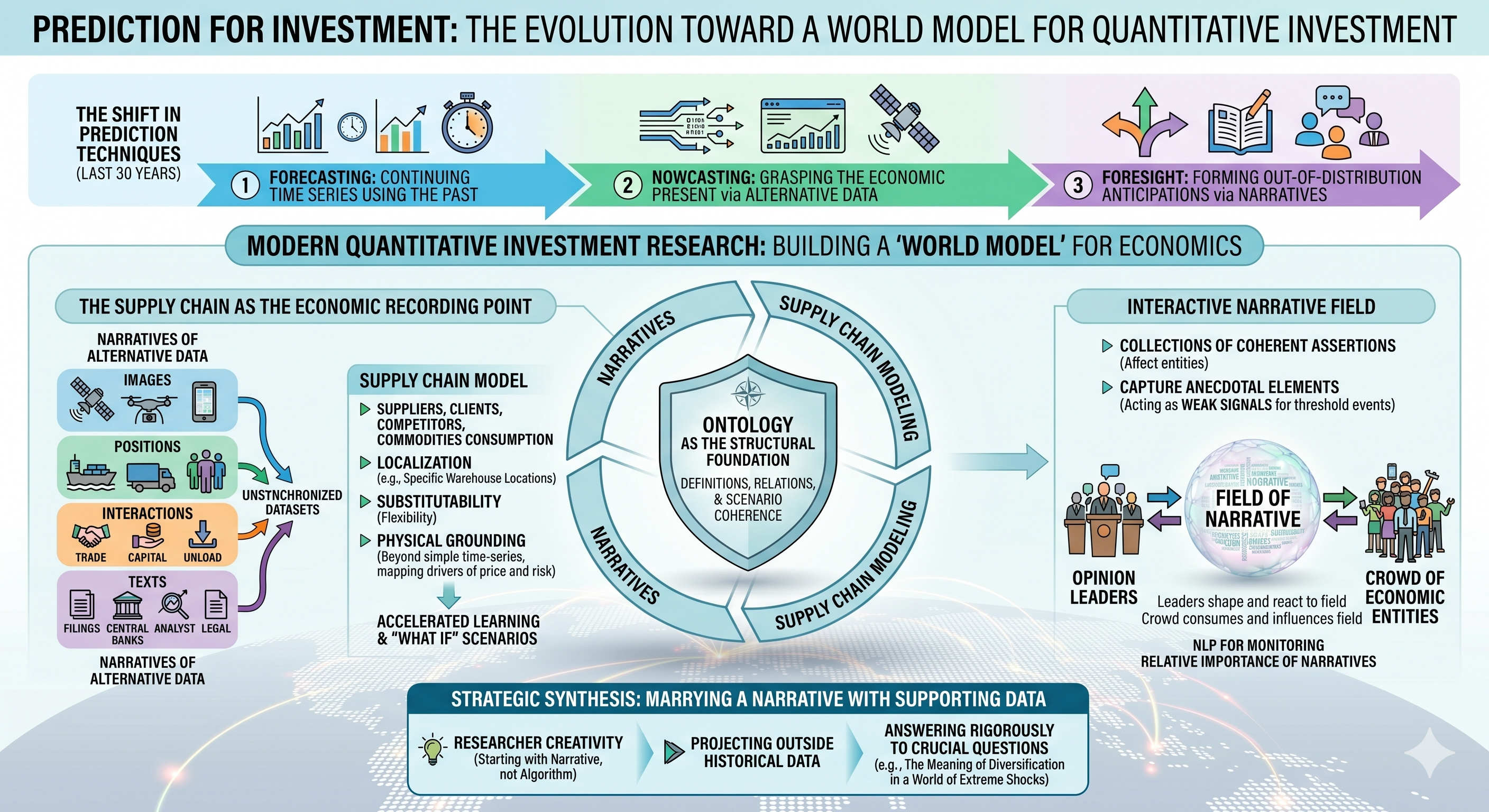
During the last 30 years, we have see successive shifts in the techniques used for prediction:
- It started by forecasting: continuing a time series using its past;
- Then alternative data pushed forward the concept of nowcasting: getting a grasp on what is occurring now on the economic ground;
- Now it the realm of foresight: forming out of distribution anticipations, with a come back of narratives.
The last step may have emerged because extreme weather events, healthcare problems and goepolitiacl events are dominating the future to be predicted.
In this short non academic note, I develop the idea that for modern quantitative investment, the conjunction of narratives and supply chain modeling represents a natural evolution of traditional forecasting toward foresight. This integrated approach can rely on ontology as the building block of a world model for economics to bridge the gap between alternative data, and in particular textual information, and the physical reality of economic activity.
The Supply Chain as the Economic Recording Point
The natures of Alternative data
The different nature of alternative datasets, i.e.
- Images (satellites, drones, mobile phones, glasses, etc)
- Positions (of ships, trucks, car, people, etc)
- Interactions (trade, capital flow, unload/load, sell, buy, etc)
- Texts (company filings / reports, central banks, legal documents, analysts, journalists, people, etc)
are not synchronized (neither in space nor in time).
The Supply chain as a structure
The supply chain can serve as a central recording point for all these datasets, encompassing suppliers, clients, competitors, commodities consumption, etc.
Localization and Substitutability: This model must be localized (e.g., identifying specific warehouse locations) and maintain flexible, realistic relations. These relations are critical for identifying substitutability—the ability to predict how a portfolio is exposed to specific events like wildfires or the closure of a shipping strait.
Physical Grounding: By mapping these physical connections, quants can move beyond simple time-series analysis to understand the fundamental drivers of price formation and risk.
Such a model, structured by a sound ontolog, can serve as a structure on which probabilistic quantities will be associated. This can be seen as a World Model; it accelerates learning (because it contains knowdge that has not te be rediscovered) and it allows “what is scenarios” mapping actions with a future state of the supply chain.
Narratives as a Regularization Layer
Narratives are collections of coherent assertions that affect linked economic entities and their relationships. They play a vital role in interpreting the data once they gave birth to a supply chain model.
A narrative acts as a regularization layer, capturing anecdotal elements. In this sense they can be considered as weak signal (a combination of a long list of quantities that can change the state of the world if it crosses a threshold).
Narratives function as a “Mean Field” (similar to atmospheric pressure), where a closed loop exists between opinion leaders and the crowd of economic entities. Leaders form narratives based on observed opinions, and the economy reacts to these narratives, triggering economic decisions—a process known as Mean Field Control.
With the progresses of Natural Language Processing, it is possible to monitor the relative importance of narratives, quantifying the current state of this mean field.
Ontology as a Transverse World Model
Ontology provides the structural “world model” that makes the marriage of narratives and supply chain data operational.
Ensuring Coherence: For a narrative to be useful in an investment context, it must be coherent; this coherence is supported by an ontology that defines terms and maintains consistent relations between entities.
Navigating Semantics and Metadata: While LLMs structure text via embeddings, they are insufficient for complex financial reasoning going off-distribution. An ontology allows researchers to navigate quantitative time series, metadata, and semantics spaces simultaneously, providing the necessary structure to anticipate the consequence of foreseen scenarios.
Strategic Synthesis in Quant Research
The goal of the next generation of quant research is to marry a narrative with supporting data. Because the structure of an investment strategy is itself a narrative, researchers must use ontologies to project themselves outside of historical data and foresight potential scenarios. This approach requires increased creativity, as the starting point for reasoning is no longer the algorithm, but the narrative anchored in a structured world model.
This short not addresses only the needed structure to reason in a field now dominated by flowing alternative data and extreme events. The availablity of such methodology will open the door to answer rigorously to crucial questions like the meaning of diversification in a world dominated by extreme and cross-sectorial shocks.