The Price Discovery Crisis?
From Mechanical Flows to Foresight Narratives
The Price Discovery Crisis? From Mechanical Flows to Foresight Narratives
In an era of passive investment dominance and geopolitical and physical risks, the most valuable alpha isn’t found in yesterday’s variance, but in the narratives that haven’t yet become liquid.
One of the mysteries of the price formation process is how the arrival of exogenous information and endogenous effects intertwin. In very short (this is not an academic posts): standard all style economists’ assumption imply that prices reflects the current level of public information (The Grossman–Stiglitz paradox says it is not that simple), and econophysicists style the way recent past of price formation process may be at least as important as new information arrival to explain price moves. The link between these two effects (information driven price discovery and flows driven price formation) have been linked by the elegant model of Kyle’85 and its sequences.
In principle, the usual double auction mechanism taking place on exchanges (Euronext, NYSE, LSE, etc) is meant to provide simultaneously two effects:
- liquidity availability around the current price (this is an endogenous feature),
- integration of (exogenous) information in price levels.
The way it takes place is currently challegenged by two means:
- A rise of passive flows, in conjuction with a shift of liquidity during the end of day batch auctions. This may lead to “less informed flows” [Bender, Clapham, and Schwemmlein (2024) ; Dieckelmann, Siciliano, and Sowiński (2024); ].
- An attraction of investors to prediction markets to understand where information points Ng et al. (2026).
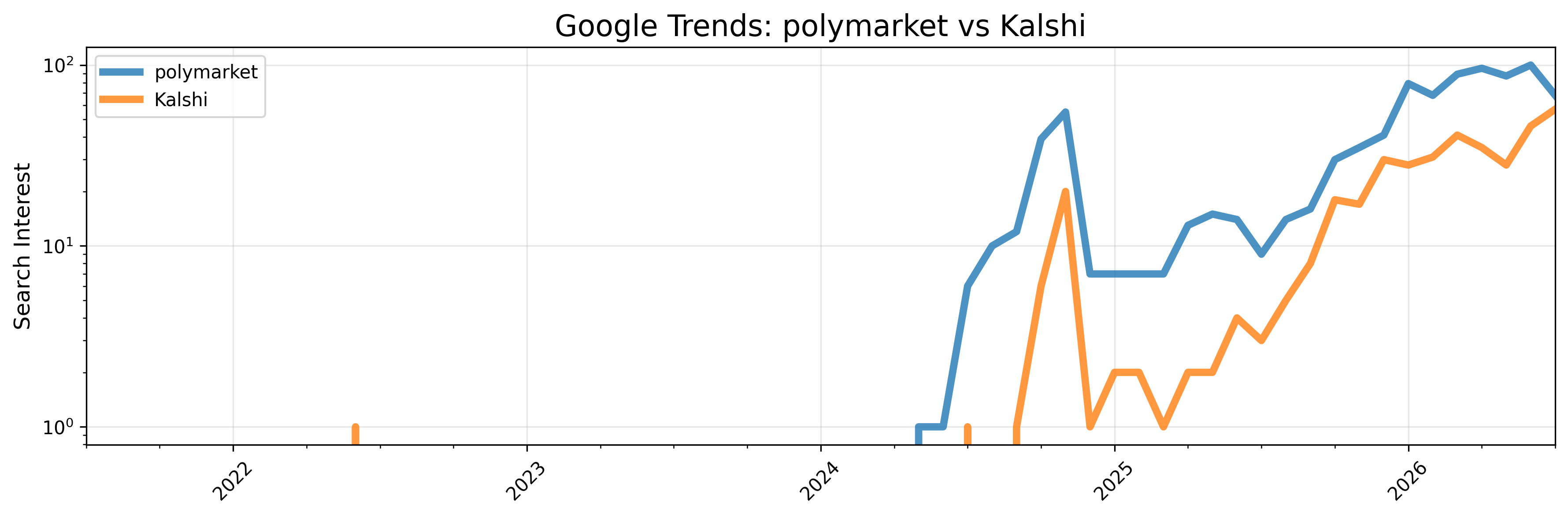
If the first point (rise of passive flows and trading at fixing auctions) is documented for long (Raillon 2020), the second point is far more recent and corresponds with the growing success of Kalshi and Polymarket (Fig 1).
In this post I decide to take seriously this attractiveness of not that much regulated places providing an appareance of price formation. A simplistic way to explain their success is first a loophole in regulation; and second that, in a culture of immediacy, retail “investors” would like to take bets 24/7, on topics that speaks more directly to them than stock picking or ETFs.
For the record, I mention briefly that the role of prediction markets like Polymarket and Kalshi is not shared by all authors (have a look at (Della Vedova 2026; Servan-Schreiber 2026).
On the extreme, one can read these two effects as
- Regular exchange provide more liquidity but less informative prices,
- Predcition markets provide a different way to transform (exogenous) information in price.
The conjunction of these two trends can be percieved as a menace to exchanges offering trading on listed equities.
The question I am pushed to discuss nowadays by stakeholders and policy makers is: can these two effects lead to a shift of information from listed markets to “another place” in such a way that trading (market) liquidity stays on passive flows and reacts lately to facts, while the price formation on prediction markets (that are less liquid, but on which the size of bets is smaller) mobilize more expertise, on topics concerning future facts?
I read this question as a “backward looking vs. forward looking” one:
Under which conditions could we see a split of the price formation: the endogenenous (reactive part) taking place on listed markets, and the exogenous (foreseeing events) part taking place on prediction markets?
This post is a thought experiment, not an academic study. It does nothing more than an attempt to explain the consequence of these two effects using two disjunct families of factors: Liquidity Factors, and Anticipative Factors.
1. Liquidity Factors (Backward-Looking Variance)
I propose to name Liquidity Factors the principal components domination the historical variance. To carry (empirical) variance, they have to be statistically observable and represent usual varations of returns, they are hence highly liquid. Because they are the result of statistical analysis, they have to be built on the past data: they are inherently backward looking. Unfortunately, in a market currently dominated by passive flows (cf. (Bogousslavsky and Muravyev 2023; Raillon 2020)), these factors may represent more the mechanical “noise” of rebalancing or of variations of AuM, rather than true foresight or arrival information (see for instance Joshi and Dash (2024) and upper references).
Keep in mind that a Buy and Hold strategy will in apparence follow price formation but will not trade more (buy or sell more) if a good (or bad) news occurs.
No doubt that if one performs a Principal Component Analysis on a sliding window (that is necessarily at least one month long for volatility and years for correlations), they will identify these factors.
An alternative is to use a factor model that is made of “characteristics” of companies (I would say in a “Daniel and Titman sense” (Daniel and Titman 1997)). Maintaining a portfolio of characteristics will generate flows only when the structure, or fundamentals, of a company change. It covers information, but only partly. Unfortunately it cannot be forward looking. If brokers are very keen to shortly add “thematic portfolios” after the fact (Brexit-exposed stocks (Carvalho and Schmitz 2022), Covid-frendly stocks, etc), these factors have a backward looking nature: they are built after the fact, and can be used to hedge the specific exposure only if investment banks agree to build on opposite position: they are not liquid by nature, they become liquid after the fact if investors wants to use them to hedge. In a sense, there is a Kyle-like price discovery taking place after the fact on such thematic portfolios: say a broker has a smart idea of proposing a Covid-friendly and a Covid-adverse portfolio at the start of the pandemic. Observing the flows of buyrs and sellers on these opposed portfolio will push their market maker to let the price go in the direction of the flow: the price of the Covid-friendly portfolio will go up when investor will want to get this exposure, etc.
I am not saying that immediate future risk cannot be expressed by a linear combination of tradable instruments, Principal Components, or Factors of Characteristics. I am saying that nothing in the structure of future risks guagantee the opportunity to observe ex-ante the portfolio driven by future events: who built a Iran-war exposed portfolio in 2025? Investor who did it could have seen the probability of the conflict rising and the reality of the US-Israel attack propagating along such a portfolio.
I am adding that it is particularly difficult to statistically identify the combination of these components or factors that is temporarily carrying “bets that matter today”.
In a sense: the Liquidity Factors are backward looking, because they are the moving average of all the important moves that mattered in the past.
2. Anticipative Factors (Latent Narratives)
True risk often lies in what information investors would need today to take bets or to hedge positions, but that cannot be found in historical charts. These “Anticipative Factors” represent unexpected, rare moves that are difficult to identify ex-ante as tradable portfolios. Because a lack of historical variance, they remain illiquid and invisible to statistical approaches.
As a consequence, it is very difficult to identify the directions of these latent factors observing only price moves (especially if the flows are less informed than a decade ago). Nevertheless, they correpond to the intensity of the belief that certain scenarios, corresponding to specific Foresight Narratives, will occur. Since it is documented that surprise moves price Bouchaud, Farmer, and Lillo (2009), let us name anticipative factors the direction of such moves.
In principle, one could imagine these anticipative factor to be portfolios corresponding to postential narratives. While market participants belive to this narrative, the flow on the coressponding anticipative factor increase, pushing the price. It may be a way to identify them. But the less informed the flows on exhanges, the more difficult to identify these narratives to weightened portfolio of tradable instrucments.
An alternative would be to simply instanciate a prediction market on these narrative: to directly put them in competition on Polymarket, or on Hypermind. Simply looking at the ones that recieve the most bets will stand for the probabilit it occurs.
There is hope that, if a crowd of informed persons has to vote for a set narratives, the majority of the crowd will reveal the currenlty dominating anticipative factor.
Before this revealing process this is a candidate narrative, and after it becomes an anticipative factor. Month after month, quarter afetr quarter, year after year: these formerly forward looking but now deprecated anticipative narratives’ moves form an average variance that shapes the Liquidity, backward looking, factors.
Conclusion: The Dual Future of Market Liquidity and Information
The structural rise of passive investing and prediction markets question how we must approach price discovery and risk management. This post suggests a two-pronged possible evolution:
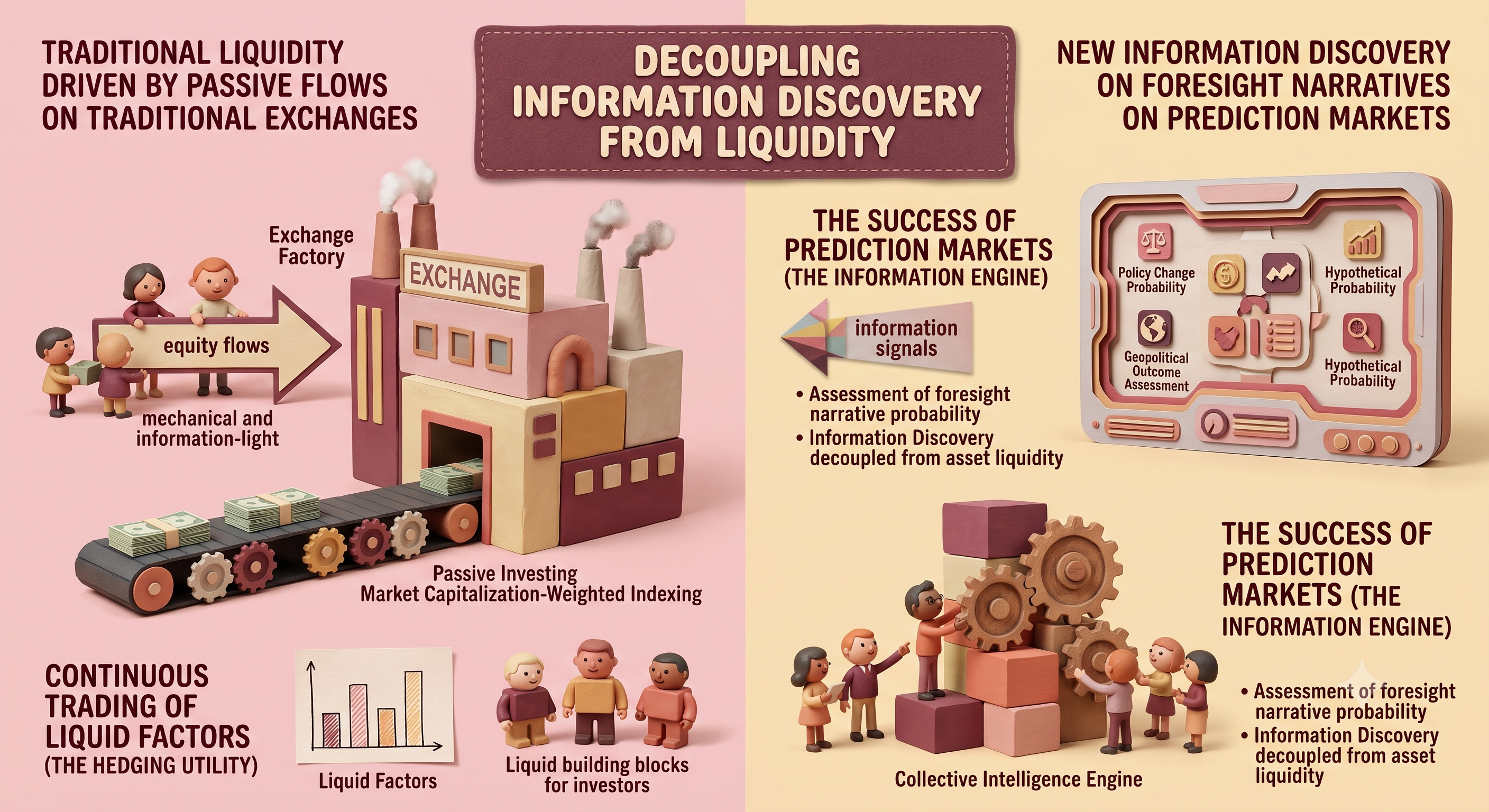
The Success of Prediction Markets (The Information Engine): As equity flows on exchanges become increasingly mechanical and information-light, prediction markets emerge as potential solution to assess the probability of foresight narratives. By decoupling information discovery from traditional asset liquidity from the pricing of the intensity of anticipative factors before they hit the tape of a listed company.
Continuous Trading of Liquid Factors (The Hedging Utility): Conversely, in such an evolution, we must treat Liquid Factors for what they are: the reliable, backward-looking plumbing of the financial system. These slow varying factors provide the “basis” that investors can use to hedge or take risk ex-post, serving as the liquid building blocks to be combined with the foresight signals discovered in prediction markets.